
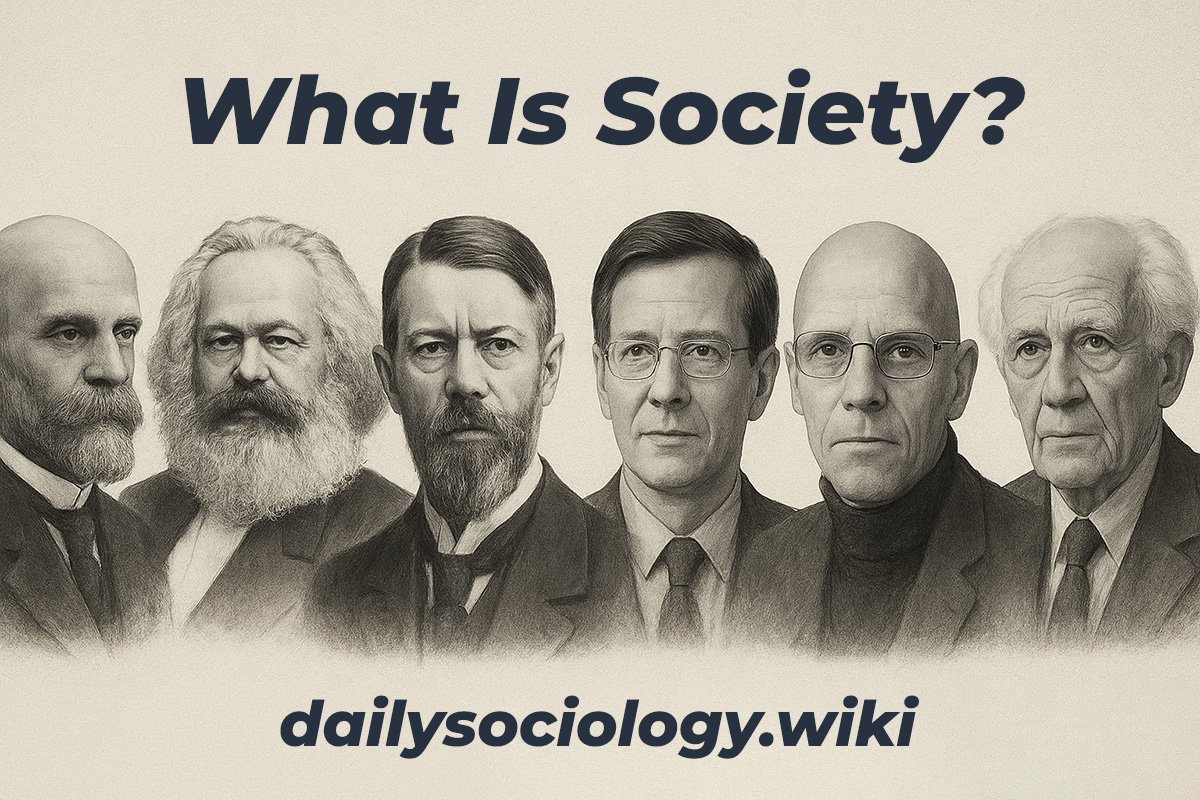
Broadly speaking, a society is a group of people who interact and share institutions, cultures, or a territory. Sociologists often define society as “a group of individuals involved in persistent social interaction or a large social group sharing the same territory” (Giddens & Sutton, 2017). In other words, society is made up of people connected by enduring relationships, norms, and organizations. Understanding society is crucial because social forces shape our lives: people shape society, but society in turn shapes human beings (Berger, 1963). How we live, the roles we play, and even our identities arise through social institutions (family, education, work, government, etc.).
Classical Sociological Perspectives
Émile Durkheim – Society as a Collective Reality
Émile Durkheim (1858–1917) emphasized that society exists as a reality of its own, not just as the sum of individuals. He argued that society is a “sui generis reality” – greater than the mere aggregation of people (Durkheim, 1982). According to Durkheim, society is constituted by social facts: patterns of behavior and thought that exist outside any one person but exert a coercive influence on individuals (Durkheim, 1982).
Durkheim also introduced the idea of collective consciousness – the shared beliefs and values that unify a society. In traditional (mechanical) societies, people were held together by common norms, while in modern (organic) societies, they are bound by interdependence through division of labor (Durkheim, 1893/1997).
Karl Marx – Society as Economic and Class Structure
Karl Marx (1818–1883) saw society primarily through an economic lens. He argued that the mode of production (forces and relations of production) shapes the superstructure (law, culture, politics) (Marx, 1859/1970). In practice, this means that who owns resources and who must labor determines society’s class structure. Historical change, for Marx, comes from conflicts between classes (Marx & Engels, 1848/1998).
Max Weber – Society as Meaningful Action and Rational Systems
Max Weber (1864–1920) emphasized social action – human action oriented toward others (Weber, 1978). He analyzed authority types (traditional, charismatic, legal-rational), showing how modern society relies increasingly on bureaucracy and formal rules. This results in the famous “iron cage” of rationalization (Weber, 1905/2002). Unlike Marx, Weber also highlighted culture and ideas, such as in The Protestant Ethic and the Spirit of Capitalism (Weber, 1905/2002).
Contemporary and Postmodern Perspectives
Anthony Giddens – Structuration and Reflexive Modernity
Anthony Giddens (1984) sought to bridge the gap between structure and agency with his structuration theory. He argued that structures are both the medium and outcome of human practices: people reproduce social systems, but once created, these systems constrain and enable further action (Giddens, 1984). He also described late modern society as increasingly reflexive and globalized (Giddens, 1991).
Michel Foucault – Society as Disciplinary Power Networks
Michel Foucault (1977) analyzed how power operates in modern societies through institutions such as prisons, schools, and hospitals. He described a disciplinary society where power is diffuse, exercised through surveillance and norms, producing “docile bodies” (Foucault, 1977). He also developed the idea of biopower – governance over entire populations through health, statistics, and regulation (Foucault, 1978).
Zygmunt Bauman – Liquid Modernity and Consumer Society
Zygmunt Bauman (2000) described contemporary societies as “liquid” – constantly shifting, with unstable identities and social bonds. Individuals must continually redefine themselves in consumer-oriented environments. He argued that society now treats its members primarily as consumers, with identities as “competitive goods in the global market” (Bauman, 2000).
Comparative Insights
Durkheim emphasized collective solidarity, Marx stressed economic conflict, Weber focused on rationalization and meaning, Giddens highlighted the duality of structure, Foucault analyzed power and discipline, and Bauman described fluidity and consumerism. These perspectives show that society is not a fixed entity but an evolving field of relations.
Conclusion
Society has been conceptualized as an objective structure (Durkheim), an economic engine (Marx), a web of meaning (Weber), a dynamic process (Giddens), a power network (Foucault), and a fluid consumer culture (Bauman). Despite differences, all agree that society profoundly shapes individuals and is itself reshaped by them. Understanding society remains vital to navigate modern challenges of globalization, inequality, and cultural change.
References
-
Bauman, Z. (2000). Liquid modernity. Cambridge, UK: Polity Press.
-
Berger, P. (1963). Invitation to sociology: A humanistic perspective. New York, NY: Anchor.
-
Durkheim, É. (1893/1997). The division of labor in society (W. D. Halls, Trans.). New York, NY: Free Press.
-
Durkheim, É. (1982). The rules of sociological method (S. Lukes, Ed., W. D. Halls, Trans.). New York, NY: Free Press.
-
Foucault, M. (1977). Discipline and punish: The birth of the prison (A. Sheridan, Trans.). New York, NY: Vintage.
-
Foucault, M. (1978). The history of sexuality, Vol. 1: An introduction (R. Hurley, Trans.). New York, NY: Pantheon.
-
Giddens, A. (1984). The constitution of society: Outline of the theory of structuration. Berkeley, CA: University of California Press.
-
Giddens, A. (1991). Modernity and self-identity: Self and society in the late modern age. Stanford, CA: Stanford University Press.
-
Giddens, A., & Sutton, P. W. (2017). Essential concepts in sociology (2nd ed.). Cambridge, UK: Polity Press.
-
Marx, K. (1859/1970). A contribution to the critique of political economy. Moscow: Progress Publishers.
-
Marx, K., & Engels, F. (1848/1998). The communist manifesto. Oxford, UK: Oxford University Press.
-
Weber, M. (1905/2002). The Protestant ethic and the spirit of capitalism (T. Parsons, Trans.). London, UK: Routledge.
-
Weber, M. (1978). Economy and society: An outline of interpretive sociology (G. Roth & C. Wittich, Eds.). Berkeley, CA: University of California Press.