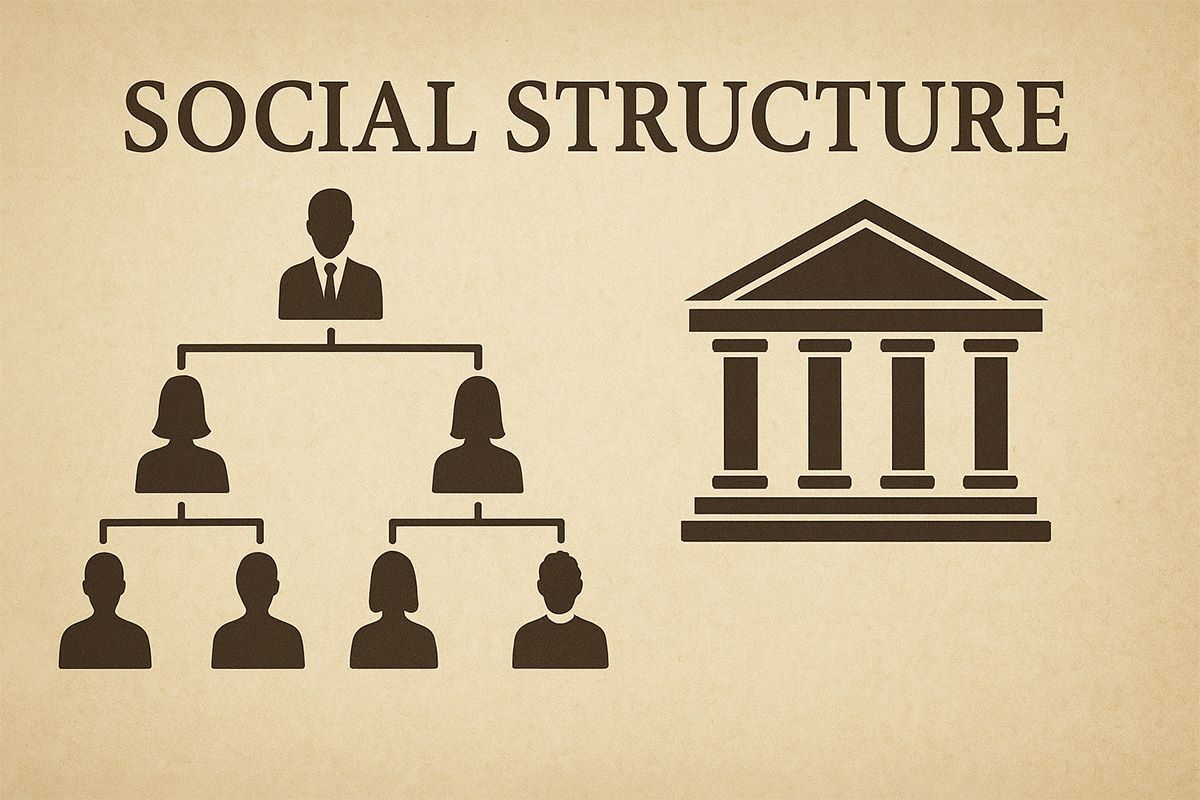
Social structure—the enduring patterns of relationships, institutions, and social roles—is a central concept in sociology. In modern Western societies, social structure manifests through class stratification, institutional frameworks (family, economy, state, etc.), and role expectations, shaped by historical and theoretical processes. This article defines social structure and surveys its classical foundations, drawing on the work of Émile Durkheim, Max Weber, Karl Marx, Talcott Parsons, Robert K. Merton, Pierre Bourdieu, and Anthony Giddens. Structural functionalism, conflict theory, and contemporary perspectives are examined, illustrating how social structures enable and constrain individual action while evolving in modernity.
Defining Social Structure
In sociology, social structure refers to patterned social arrangements and institutional frameworks that organize society. It encompasses institutions (family, education, economy, law, religion), networks of social relations, and shared norms and roles. Durkheim (1984) conceptualized these patterns as social facts—ways of acting, thinking, and feeling external to the individual that exert coercive power over behavior. Social structures are not reducible to individual intentions; they exist independently and influence behavior, shaping how individuals relate to one another and to society as a whole (Durkheim, 1984).
Structural-functionalists view social structure as an integrated system in which institutions serve specific functions. Parsons (1951) argued that each part of society—economy, family, education, polity—contributes to the overall stability and functioning of the social system. Conversely, conflict theorists, including Marx (1976) and Weber (1978), highlight how social structures reflect and reinforce inequalities in wealth, power, and status.
In modern Western societies, social structures such as class, law, and the market economy shape life chances and opportunities. Weber (1978) emphasized that social position is multidimensional, determined not only by economic resources (class) but also by status (prestige) and political power (party). These stratifications allocate resources and opportunities in patterned ways that persist over time.
Classical Foundations
Durkheim and Social Solidarity
Émile Durkheim (1984) emphasized that social structures are essential for social cohesion. He distinguished mechanical solidarity, characteristic of pre-modern homogeneous societies, from organic solidarity, typical of modern societies where specialization creates interdependence. In mechanically solidary societies, social roles are uniform and cohesion is based on similarity. In organically solidary societies, social cohesion arises from the complementary functions of diverse roles and institutions, such as education, labor, and governance (Durkheim, 1984).
Marx and Conflict
Karl Marx (1976) provided a conflict-oriented perspective, focusing on the economic structures of society. He argued that class divisions, particularly between the bourgeoisie (owners of capital) and the proletariat (workers), are central to understanding social structure. Economic institutions, laws, and cultural norms often serve to perpetuate the dominance of capital-owning classes, creating structural inequalities that persist over time (Marx, 1976).
Weber and Multi-Dimensional Stratification
Max Weber (1978) expanded the analysis of social structure beyond economics, identifying three dimensions of stratification: class, status, and party. Weber argued that class refers to economic position, status to social prestige, and party to political influence. In Western societies, these dimensions intersect to shape opportunities, lifestyles, and life chances, while bureaucratic structures enforce rational-legal authority and maintain organizational order (Weber, 1978).
Structural Functionalism
Talcott Parsons (1951) and Robert K. Merton (1968) developed structural-functionalism as a theoretical framework for understanding social structure. Parsons conceptualized society as a system of interrelated parts fulfilling functional prerequisites: adaptation (economic system), goal attainment (political system), integration (social cohesion), and pattern maintenance (norm reproduction). Merton refined this approach by distinguishing manifest functions, latent functions, and dysfunctions within social institutions, highlighting both intended and unintended effects (Parsons, 1951; Merton, 1968).
In Western societies, structural functionalism emphasizes how institutions like education, family, and government contribute to social stability and cohesion. Schools socialize youth and transmit cultural norms, families nurture individuals, and political institutions regulate conflict and allocate resources.
Conflict Theory
Conflict theory highlights power struggles within social structures. Marx (1976) argued that economic inequality under capitalism generates structural advantages for the ruling class. Weber (1978) extended this by analyzing how status and political power also structure inequalities. Bourdieu (1986) introduced the concept of capital (economic, cultural, social) and habitus to explain how social positions are reproduced. Habitus, the internalized dispositions shaped by one’s social position, guides behavior and perpetuates structural inequalities unconsciously (Bourdieu, 1986).
Agency and Structuration
Anthony Giddens (1984) proposed structuration theory, emphasizing the duality of structure: social structures both constrain and are reproduced by human agency. Structures exist as rules and resources that guide action, yet these actions simultaneously sustain or transform the structures. In Western societies, this framework explains how institutions like markets, governments, and social networks persist and adapt in response to human practices (Giddens, 1984).
Manifestations in Modern Western Societies
In practice, social structure manifests in class hierarchies, institutional organization, and role systems:
-
Class Structure: Upper, middle, and lower classes define life chances, wealth, and social mobility (Marx, 1976; Weber, 1978).
-
Institutions: Family, education, economy, polity, and religion regulate behavior and coordinate societal functions (Parsons, 1951; Durkheim, 1984).
-
Social Roles: Statuses and roles, including ascribed (gender, ethnicity) and achieved (occupation, credentials), shape expected behavior (Parsons, 1951; Merton, 1968).
-
Dynamics: Globalization, technology, and social movements influence institutional evolution, while structural patterns continue to constrain and guide individual action (Giddens, 1984; Bourdieu, 1986).
Conclusion
Social structure remains central to understanding modern Western societies. Classical sociologists such as Durkheim, Marx, Weber, Parsons, Merton, Bourdieu, and Giddens provide complementary perspectives: functional integration, conflict and inequality, and the interplay of structure and agency. In Western societies today, enduring institutions, class hierarchies, and patterned roles coexist with dynamic social processes. Social structures both constrain and enable individual behavior, reproducing stability while accommodating change.
References
Bourdieu, P. (1986). The forms of capital. In J. Richardson (Ed.), Handbook of theory and research for the sociology of education (pp. 241–258). Greenwood.
Durkheim, É. (1893/1984). The division of labor in society (W. D. Halls, Trans.). Free Press.
Giddens, A. (1984). The constitution of society: Outline of the theory of structuration. University of California Press.
Marx, K. (1867/1976). Capital: A critique of political economy (Vol. 1; B. Fowkes, Trans.). Penguin.
Merton, R. K. (1968). Social theory and social structure. Free Press.
Parsons, T. (1951). The social system. Free Press.
Weber, M. (1922/1978). Economy and society (G. Roth & C. Wittich, Eds.). University of California Press.