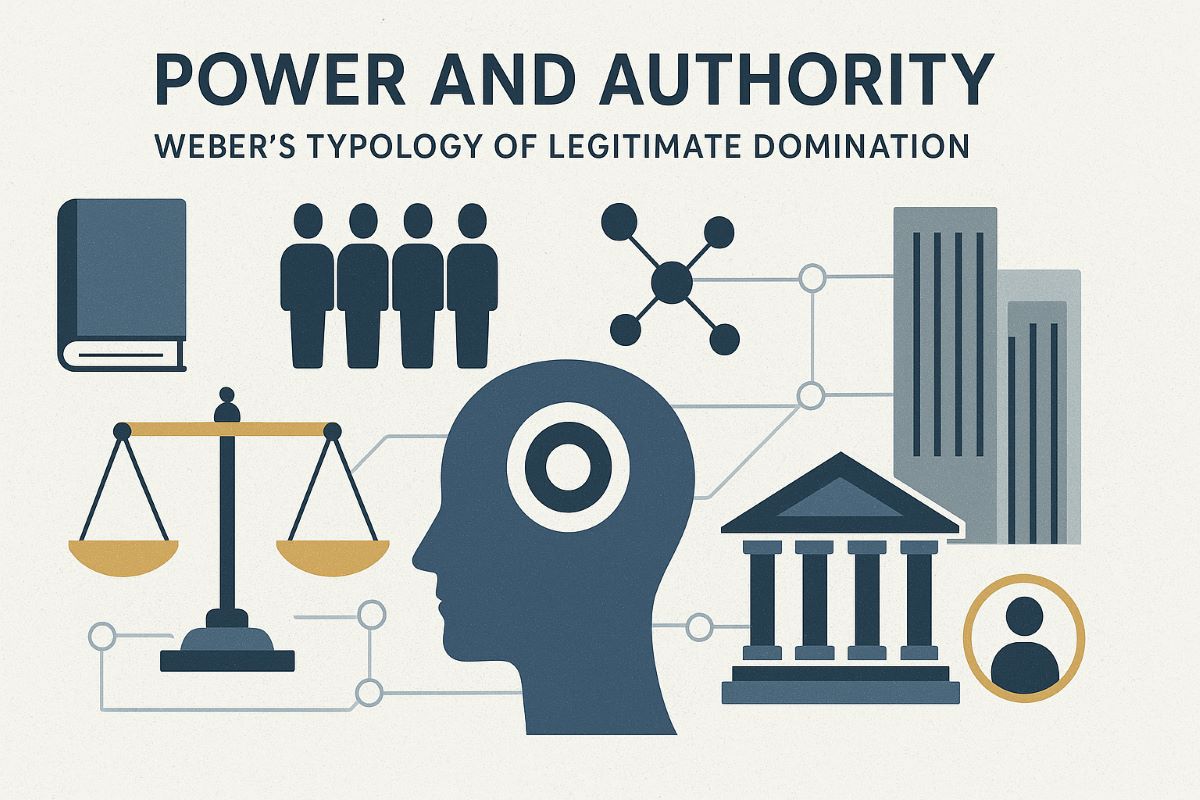
Analyses of power and authority occupy a central place in political sociology. Max Weber’s tripartite typology of legitimate domination—traditional, charismatic, and legal-rational authority—remains one of the most influential conceptual tools for explaining why subjects obey rulers and how different political orders sustain legitimacy (Weber, 1978). This article offers a focused conceptual and critical reading of Weber’s typology, situating it within broader debates about the stability and transformation of political authority. I first outline the conceptual core of each authority type, then consider Weber’s account of the dynamics among them (including routinization and bureaucratization), and finally examine contemporary reassessments of charisma and democratic transformation. Throughout, the discussion is attentive to Weber’s intent to explain the belief in legitimacy that undergirds voluntary obedience and to more recent scholarship that re-reads charisma in light of democratic theory (Weber, 1978; Magalhães, 2022).
Weber’s typology: the three pure types of legitimate domination
Weber’s core contribution to the sociology of domination lies in his ideal-typical division of legitimate rule into three analytically distinct forms: traditional, charismatic, and legal-rational. Traditional authority rests on the sanctity of long-standing customs and inherited status; obedience is given because “things have always been done this way” and the ruler’s right is embedded in continuity and habit (Weber, 1978). Charismatic authority, by contrast, is personal: legitimacy emerges from the perceived extraordinary qualities of a leader, whose followers submit out of devotion to the person and to the belief that the leader embodies special gifts or mission. Legal-rational authority is grounded in impersonal rules, codified law, and office-based competence; legitimacy derives from belief in the validity of established procedures and legally constituted offices (Weber, 1978). These ideal types are analytic devices rather than descriptions of pure empirical cases; real political orders commonly combine elements from more than one type.
Mechanisms of legitimation and the sociology of obedience
Weber frames legitimacy as a social-psychological disposition—what he calls a “belief in legitimacy”—that explains why subjects comply without immediate coercion (Weber, 1978). Each authority type mobilizes a distinct justificatory grammar: tradition appeals to historical continuity and sacred precedent; charisma mobilizes emotive devotion and a personal bond; legal-rational authority appeals to formalised norms and instrumental-rational calculation of duty. Importantly, Weber’s typology is not merely classificatory: it helps explain different mechanisms of administrative organization and recruitment, the character of leadership selection, and the social consequences of routinization. For instance, legal-rational authority typically fosters bureaucratic administration with meritocratic recruitment and rule-bound action; charisma tends to resist institutionalization and is often unstable unless it is routinized into other forms of domination.
Routinization, transformation, and the problem of stability
A persistent theme in Weber’s analysis is the tension between the transformative force of charisma and the stabilizing tendencies of tradition and legal-rational structures. Charismatic movements commonly face the problem of succession: how can an extraordinary, personal authority be preserved after the original leader’s departure? Weber’s answer is routinization—the conversion of charismatic claims into office, law, or tradition—which typically results in a partial loss of the original revolutionary content and a gain in administrative stability (Weber, 1978). Similarly, the expansion of rational-legal authority, associated with capitalist development and bureaucratization, creates highly efficient but potentially ossified forms of rule that may stifle innovation. Weber therefore portrays political modernization as a double-edged process: increasing rationalization secures predictable governance while simultaneously eroding sources of moral and personal commitment that can animate political change (Weber, 1978).
Reassessing charisma and democracy: contemporary perspectives
Recent scholarship has revisited Weber’s treatment of charismatic authority in light of modern democratic transformations. Pedro T. Magalhães (2022) argues that Weber’s interest in charisma should not be reduced to his episodic defense of plebiscitary leadership in the Weimar context; rather, Weber’s concept of charisma centrally addresses the “enigma of significant social and political change” and the paradox that democratic movements often depend upon personal authority to produce collective transformation (Magalhães, 2022). From this vantage, charisma plays a complex role in democracies: it can catalyze demands for change and mobilize masses, but it also carries the risk of becoming an engine of authoritarian personalization when routinization fails or when legal-rational checks are weak. Thus, contemporary theorists have employed Weber to illuminate dilemmas of populism, leader-centered politics, and the personalization of electoral democracy. Magalhães emphasizes that Weber’s ambivalence—recognizing charisma’s revolutionary potential while warning of its perils—remains analytically valuable for understanding present-day political dynamics.
Limits and extensions of Weber’s typology
Scholars have debated whether Weber’s three pure types exhaust the forms of legitimate domination or whether additional or hybrid forms should be recognized. Critics point out that many modern actors (e.g., technocratic experts, charismatic entrepreneurs within bureaucracies, or ideologically sustained movements) may not fit neatly into the tripartite schema. Yet Weber’s methodological use of ideal types allows for such empirical complexity: the typology functions as a heuristic that highlights dominant justificatory principles while permitting mixed or transitional cases. Moreover, Weber’s framework directs attention to the sociological mechanisms—belief, routinization, bureaucratization—that explain why particular justificatory scripts succeed or fail. Contemporary work that seeks to extend Weber (for example, by analyzing substantive-rational forms of authority or the role of professional legitimacy) generally does so by elaborating the internal logics Weber identified rather than by discarding his core insight about the social bases of legitimacy.
Implications for empirical analysis and normative theory
Weber’s typology offers concrete tools for empirical research: it suggests categories for coding political regimes, organizational structures, and leadership styles, and it foregrounds processes (conversion, routinization, institutionalization) that can be operationalized in historical and comparative studies. Normatively, the typology invites reflection on trade-offs between stability and responsiveness: legal-rational systems yield predictability and rule-bound fairness, but may bottleneck transformative change; charismatic politics can inject agency and moral urgency, yet can also undermine rule-based checks. For scholars and practitioners concerned with democratic resilience, Weber’s work thus argues for institutional designs that preserve political responsiveness without abdicating legal-rational constraints—a problem that is strikingly relevant in contemporary debates about populism and the personalization of politics (Magalhães, 2022).
Conclusion
Max Weber’s typology of legitimate domination remains a durable and generative framework for understanding why people accept authority and how different orders of rule persist or transform. By distinguishing traditional, charismatic, and legal-rational sources of legitimacy, Weber supplies both analytic clarity and a dynamic account of political evolution through routinization and bureaucratization (Weber, 1978). Contemporary scholarship—exemplified by recent reappraisals of charisma in democratic settings—demonstrates the continuing relevance of Weber’s ambivalent diagnosis: the same social forces that enable change can also erode the institutional safeguards needed to prevent authoritarian personalization (Magalhães, 2022). For students and researchers of power and authority, Weber’s typology thus remains indispensable: it is simultaneously an interpretive lens, a research program, and a normative prompt to weigh the competing goods of stability and transformative agency.
References
- Magalhães, P. T. (2022). Charisma and democracy: Max Weber on the riddle of political change in modern societies. Topoi, 41, 69–78.
- Weber, M. (1978). Economy and society: An outline of interpretive sociology (G. Roth & C. Wittich, Eds.). University of California Press.