
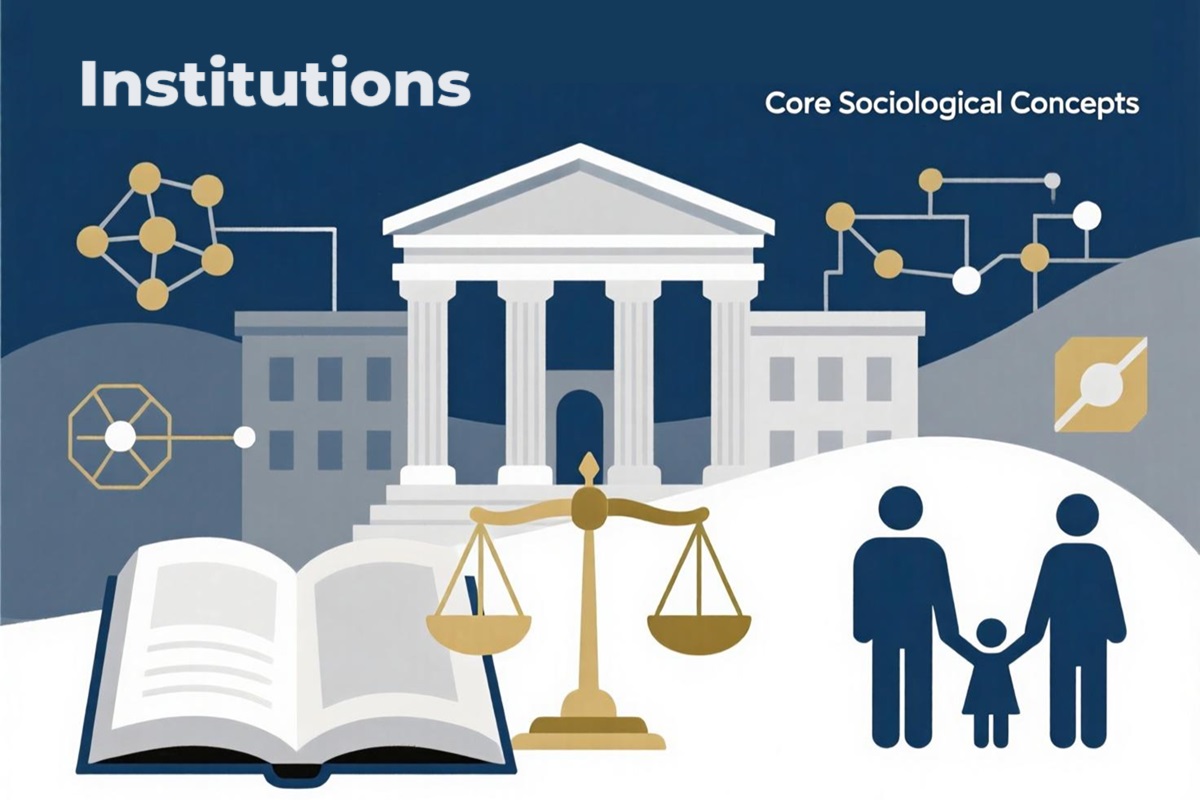
Institutions—understood as enduring rules, norms, and structures that shape human interaction—constitute the scaffolding of social life. They orient individual behaviour, coordinate collective action, and mediate the distribution of resources and meanings across society. Classic institutional theory situates institutions as the “rules of the game” that reduce uncertainty and create predictable patterns of exchange and cooperation (North, 1990, p. 3). Building on that foundational claim, this article examines four central social pillars—family, religion, education, and the economy—as institutional domains that mutually reinforce and sometimes contest one another. The aim is conceptual: to show how institutional characteristics (formal/informal rules; enforcement mechanisms; transaction and transformation costs) shape the functioning of these pillars and how, reciprocally, the pillars influence institutional stability and change. The analysis draws primarily on the institutional framework developed by Douglass C. North (1990) and on contemporary work that clarifies how religious institutions generate distinct forms of social capital with tangible social effects (Shapiro, 2022).
Theoretical framework: institutions, incentives, and stability
Douglass North’s institutional perspective foregrounds two core propositions. First, institutions—both formal (laws, constitutions) and informal (norms, customs)—are humanly devised constraints that structure interaction and thereby shape the incentive environment for actors (North, 1990). Second, institutional arrangements influence transaction and transformation costs and are therefore central to patterns of economic and social performance over time. From this vantage, the family, religion, education, and economic systems are not merely functional subsystems; they are institutional arrangements composed of rules, roles, enforcement practices, and embedded expectations that channel behaviour. Changes in one domain can produce path-dependent shifts across others because institutional change is mediated by learning, organizational responses, and the costs of altering entrenched practices (North, 1990).
North’s definition is often cited for its clarity: “Institutions are the rules of the game in a society, or, more formally, are the humanly devised constraints that shape human interaction.” (North, 1990, p. 3). This definition highlights institutions’ dual character as prescriptive (rules) and consequential (shaping incentives and outcomes). In practice, institutions operate through a mixture of codified regulations, routine practices, and shared meanings; the relative weight of formal versus informal constraints varies across the four pillars examined below.
Family as an institutional pillar
As an institution, the family organizes reproduction, socialization, and primary care through normative expectations and role prescriptions. Family institutions define obligations (e.g., parent–child duties), distribute caregiving labour, and socialize the next generation into societal norms. From an institutional standpoint, families reduce uncertainty about intergenerational transfers (of resources, values, and social capital) by establishing expectations and sanctioning deviations. Families also operate as semi-formal organizations—households and kin networks—that implement and adapt rules in response to economic and policy environments. Changes in labour markets, welfare regimes, or legal frameworks (e.g., inheritance law, parental leave policies) alter the transaction costs associated with family strategies and can reconfigure household decision-making. In North’s terms, shifts in the external institutional environment change the incentive structure facing families and thus can precipitate adaptive institutional change within family systems (North, 1990).
Religion and social capital: institutional mechanisms and effects
Religious institutions exemplify how institutional embeddedness produces distinct forms of social capital—relational goods, norms of reciprocity, and dense networks that facilitate cooperation. Recent syntheses emphasize that religious participation produces both bonding and bridging capital and that religious capital can operate as a “protective canopy” for adherents’ social and health outcomes by supplying resources, trust networks, and normative constraints (Shapiro, 2022). Religious institutions combine doctrinal content (beliefs), organizational structures (congregations, clergy), and ritualized practices that create durable commitments and reputational sanctions; these features lower the costs of repeated interaction and help enforce cooperative norms.
Shapiro’s analysis is useful for clarifying mechanism: religious institutions do not merely supply social support; they instantiate a distinct capital—religious capital—that intersects with but is analytically separable from generalized social capital (Shapiro, 2022). Where family networks provide intimate, private forms of support, religious institutions can extend reciprocal obligations across broader networks and link individuals to community-level resources. In institutional terms, religion exemplifies how informal constraints (rituals, moral injunctions) and organizational forms jointly produce predictable social effects that influence other pillars—most notably education (through schools affiliated with faith communities) and the economy (through norms shaping consumption, saving, and entrepreneurship).
Education: institutional transmission of skills and norms
Education serves as an institutional mechanism for the transmission of cognitive skills, social norms, and civic dispositions. As a public and private institution, schooling formalizes pedagogy, credentialing, and certification rules that structure labour-market access and status hierarchies. From an institutional perspective, education reduces informational asymmetries and lowers transaction costs associated with hiring, contracting, and large-scale coordination by providing credible signals (credentials) and shared cognitive repertoires. Importantly, educational institutions mediate intergenerational reproduction of social capital: family background and community networks interact with school structures to shape trajectories of opportunity. The institutional durability of education—its formal rules, accreditation systems, and governance arrangements—makes it both a site of reproduction and a potential locus of reform; altering school governance or credentialing criteria can have long-run effects on economic performance precisely because education modifies the skill distribution and incentives across society (North, 1990).
Economy as institutional matrix
The economy is simultaneously a set of market institutions (property rights, contract law, regulatory regimes) and a social arena where the rules of exchange are operationalized. North’s thesis about institutions and economic performance centers on how institutions define the feasible set of choices and determine transaction costs that shape growth trajectories (North, 1990). Economic institutions interact with family, religion, and education in multiple ways: they shape household strategies (labour supply, savings), influence the incentives for investment in human capital, and condition the organizational forms that emerge in civil and religious spheres. Conversely, normative constraints arising in family and religious institutions—trust, reputation, social sanctions—can substitute for or complement formal contractual enforcement, thereby affecting market functioning. Thus, the economy cannot be fully understood without attending to the institutional matrix that embeds markets in social relations.
Interaction, complementarity, and tension among pillars
The four pillars exhibit complementarity: educational credentials facilitate economic participation; family and religious networks provide social capital that supports both schooling and labour-market access; and economic institutions create the incentives that shape family and educational strategies. Yet tensions arise when institutional logics diverge—e.g., market imperatives may erode traditional family roles, or secular educational norms may conflict with religious prescriptions. North’s emphasis on path dependence helps explain why institutional change is often incremental and uneven: entrenched rules, vested interests, and organizational learning create inertia, while shocks (economic crises, policy reforms) open contingent windows for institutional reconfiguration (North, 1990). Contemporary analyses of religious social capital suggest similar dynamics: the durability of religious norms can buffer communities in crises but may also constrain rapid institutional innovation when norms are at odds with reformist agendas (Shapiro, 2022).
Policy implications and prospects for institutional reform
If institutions shape outcomes via incentives and transaction costs, then effective policy must attend to rule structures, enforcement mechanisms, and the informal constraints that sustain practices. Policies that ignore family and religious forms of social capital risk unintended consequences; conversely, policies that leverage existing networks—through partnerships with faith-based organizations or family-support programs—can augment effectiveness. Educational reform that retools credentialing and governance can shift long-run economic prospects, but such reforms must be sensitive to the social embedding of schooling within family and community norms. The institutional approach advises incremental, context-sensitive reform that recognizes path dependence and seeks to lower the costs of cooperative behaviour via credible, enforceable rules and supporting organizational forms (North, 1990).
Conclusion
Understanding family, religion, education, and the economy as institutional pillars clarifies how societies structure incentives, reproduce norms, and coordinate collective action. North’s institutional framework provides a robust analytic lens for seeing how rules—formal and informal—mediate performance and change (North, 1990). Contemporary work on religious capital complements this perspective by detailing mechanisms through which religious institutions generate social resources that affect health, cohesion, and cooperation (Shapiro, 2022). Together, these perspectives underscore that policy and scholarly analysis must treat institutions not as background context but as active determinants of social trajectories. Institutional reform thus requires attention to rules, enforcement, organizational capacities, and the informal norms that sustain social life across the four pillars.
References
- North, D. C. (1990). Institutions, institutional change and economic performance. Cambridge University Press.
- Shapiro, E. (2022). A protective canopy: Religious and social capital as elements of a theory of religion and health. Journal of Religion and Health, 61(6), 4466–4480.