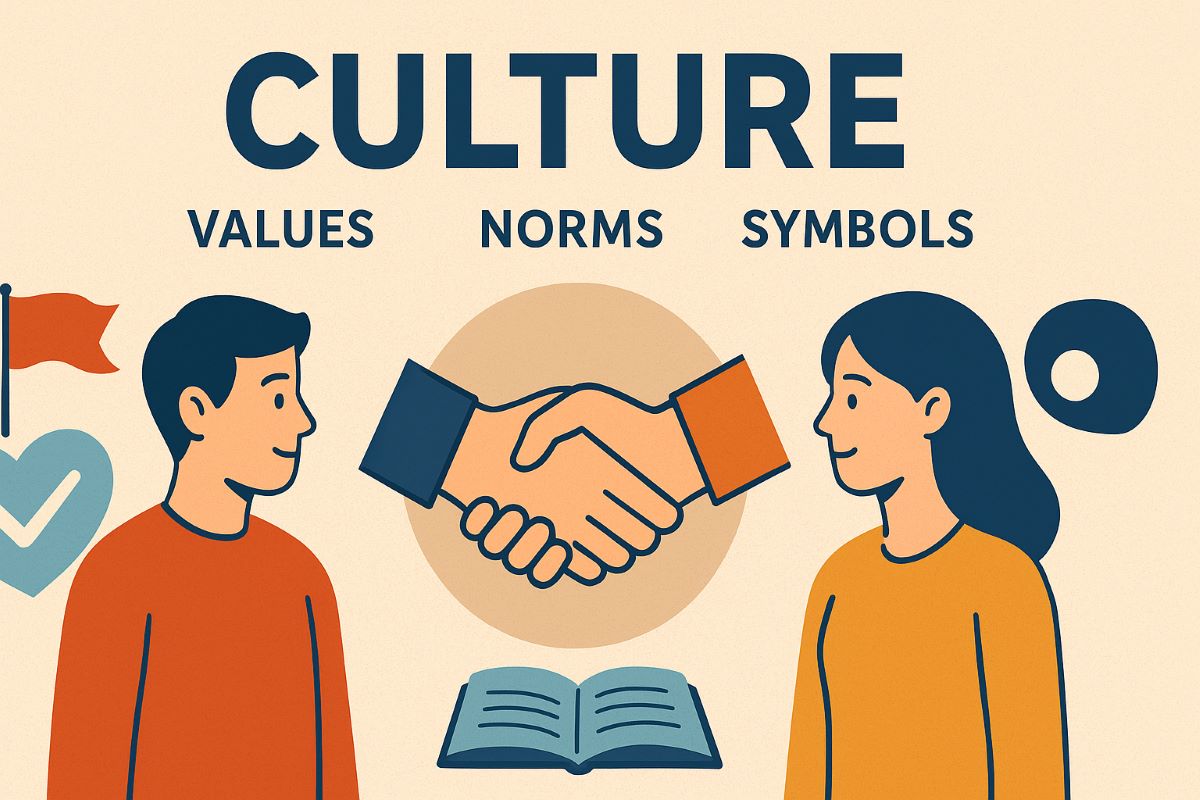
Culture is the collective “way of life” of a group, encompassing the knowledge, beliefs, customs, and practices that individuals acquire as members of society. Early anthropologists defined culture expansively: Edward Tylor described it as “that complex whole which includes knowledge, belief, art, morals, law, custom, and any other capabilities and habits acquired by man as a member of society” (Tylor, 1871). Likewise, Kroeber and Kluckhohn emphasized that culture consists of shared patterns of behavior “acquired and transmitted by symbols,” with ideas and values at its core (Kroeber & Kluckhohn, 1952). Contemporary scholars similarly view culture as a kind of mental “programming” distinguishing groups (Hofstede, 1991). In sum, culture includes both tangible elements (artifacts, technology) and, crucially, non-material elements (values, norms, symbols) that guide how people interpret the world.
Culture pervades everyday life. It provides a framework of meaning: the language we speak, the rituals we perform, and the ideas we hold about right and wrong are all cultural. Through socialization, individuals learn their culture’s values and norms and interpret symbols that carry shared meaning (OpenStax, 2020b). For instance, flags, religious icons, and gestures are symbols whose meanings must be taught. In this way, culture shapes perceptions and behavior, creating a common “script” for social interaction. Because cultures vary (for example, Western versus Eastern societies differ on many values and practices), studying culture involves comparing values, norms, and symbols across contexts.
Values: Core Beliefs and Ideals
Values are abstract ideas about what is good, desirable, or worthy in a society. They represent a culture’s deepest “core,” providing ideals that guide behavior and judgment. As one sociology text notes, “values are abstract concepts that certain kinds of behaviors are good, right, ethical, moral and therefore desirable” (OpenStax, 2020a). In practice, values might include ideals such as freedom, equality, respect for elders, or community welfare. For example, individual freedom is a prominent value in many Western democracies, whereas harmony and filial piety are strong values in Confucian-influenced East Asian cultures. These abstract values underlie more specific norms and inform how people prioritize goals in life.
Values have been systematically studied by social scientists. Milton Rokeach’s classic work identified “terminal values” (end goals like happiness, social justice, or security) and “instrumental values” (modes of behavior like honesty or ambition) that people rank by importance (Rokeach, 1973). Rokeach found that individuals can reliably order about eighteen key values—e.g., equality, family security, or an exciting life—and that these ranked priorities vary by social background and modestly predict behavior (Rokeach, 1973). In a settled social context, Rokeach argued, values fine-tune behavior by helping individuals resolve choices among competing ends (Rokeach, 1973).
On a cultural scale, Shalom Schwartz and colleagues identified universal dimensions of values. In Schwartz’s framework, societies can be characterized by tensions between broad value types. For instance, Conservation (valuing security, conformity, tradition) contrasts with Autonomy (valuing individual independence and creativity), while Hierarchy (valuing authority and status) contrasts with Egalitarianism (valuing equality and social justice). Schwartz formalized basic value domains (e.g., conformity, tradition, benevolence, stimulation) and their oppositions (Schwartz, 1992, 2006). A culture that scores high on Conservation (common in societies emphasizing group cohesion) will stress norms like obedience and respect, whereas a culture high on Autonomy (seen in many Western societies) will promote norms of personal expression and tolerance of difference. In this way, values shape the worldview of a culture and underlie the norms that prescribe behavior.
Summary. Values are the intangible ideals at the heart of culture. They are relatively enduring and are learned through family, education, religion, and media. Members of a culture typically share a value system (though individuals may differ), and these shared values lend coherence to societal goals. When values conflict—within an individual or between groups—social debates over norms and policies often result. Values thus provide the foundation on which norms and symbols are built and interpreted.
Norms: Social Rules and Expectations
Norms are the rules and expectations by which a society guides the behavior of its members. Unlike values (which are broad ideals), norms are more specific prescriptions or prohibitions—informal or formal—for how to behave in particular situations. UNICEF defines social norms as “perceived informal, mostly unwritten, rules that define acceptable and appropriate actions within a given group” (UNICEF, 2021). In other words, norms tell people “this is how we do things here.” For example, greeting norms (handshakes in the U.S., bows in Japan), table manners, or workplace etiquette are all norms. Norms often derive from values: a culture that values politeness will have norms about saying “please” and “thank you,” whereas a culture that values filial respect will have norms about addressing elders with honorifics.
Sociologists distinguish types of norms. Folkways are everyday customs that people follow for convenience or courtesy (e.g., using utensils to eat, queuing in line). Violation of folkways is usually not a serious moral issue (though it may be rude). Mores, by contrast, are norms that embody moral judgments about right and wrong (e.g., prohibitions on stealing or harming others). Mores are often backed by strong sanctions or laws, because they protect core values of a culture (OpenStax, 2020a). Some norms can even be codified into formal laws and institutional rules, whereas others remain informal and are enforced through social approval or disapproval.
Norms are learned through socialization. Children absorb norms by observing others (parents, peers, teachers), hearing explicit instructions, and experiencing the consequences of conformity or deviance (OpenStax, 2020b). Groups use rewards (praise, privilege) or punishments (ostracism, fines, imprisonment) to encourage norm-following; norms are “held in place by social sanctions for non-adherence and social benefits for adherence” (UNICEF, 2021). If someone breaks a norm, they risk social punishment: in extreme cases, this can range from gossip and shaming to legal penalties. For instance, failing to greet someone in a culture that values polite salutations may bring scowls, while violating traffic laws leads to fines or arrest.
Research highlights cross-cultural differences in how strictly norms are enforced. Michele Gelfand’s cultural psychology work finds that some societies are “tight” (highly rule-bound) and others “loose” (more permissive). In tight cultures (e.g., Japan or Singapore), normative expectations are strict and even small deviations are punished; in looser cultures (e.g., Greece or Brazil), norms are more flexible and a wider range of behavior is tolerated (Gelfand, 2019). This tight–loose continuum correlates with cultural histories: societies that historically faced threats (e.g., invasions, resource scarcity) tend to develop tighter norms for cooperation, whereas more stable societies afford greater individual choice. Thus, even the strength of norms is culturally patterned.
Summary. Norms operationalize values into daily practices. They tell members of a culture how to act in social roles (e.g., gender roles, professional roles) and situations (e.g., greetings, eating, negotiation). The interaction between values and norms is dynamic: values suggest what ought to be (e.g., “Equality is good”), while norms determine how people should behave to realize those values (e.g., “Treat everyone the same in turn-taking”). Together, shared norms help maintain social order and a sense of predictability—people can anticipate others’ actions because they share common rules.
Symbols: Shared Meaning and Communication
Symbols are any objects, words, or actions that carry particular meanings recognized by people who share a culture. They are the vehicles through which ideas and values are communicated. Anthropologists emphasize that symbols are foundational to culture—virtually all acts, objects, and utterances are symbolically loaded within a cultural frame (OpenStax, 2021a). A symbol’s connection to what it represents is arbitrary and learned. For example, the letters of a written alphabet have no inherent link to the sounds they denote; their meaning is given by cultural convention (OpenStax, 2021b). Likewise, a white wedding dress symbolizes purity in many Western cultures, whereas white symbolizes mourning in parts of Asia—the same color symbol has different meanings in different cultural symbol-systems.
Language is the most fundamental symbolic system. Through language, speakers encode all manner of cultural concepts. Beyond language, countless other symbols permeate culture: religious icons (cross, crescent, lotus), national symbols (flags, anthems), gestures (thumbs-up, nodding), and even numerical symbols (e.g., the number 13 as unlucky in the West) all convey shared meaning. Rituals such as weddings, funerals, or festivals also function symbolically, representing transitions or values (e.g., a graduation ceremony symbolizes achievement and a passage into adulthood). Each cultural group has a vast repertoire of symbols. As one open-text anthropology source notes, “Everything one does throughout one’s life is based and organized through cultural symbolism” (OpenStax, 2021a). Symbols require interpretation within a cultural context and often have layers of meaning that insiders understand; outsiders may misread them—e.g., indigenous spiral motifs (the “whirl log”) in Native American art were later misinterpreted by outsiders because of their resemblance to the Nazi swastika, despite a completely different indigenous meaning (OpenStax, 2021a).
In short, symbols allow people to express abstract ideas and to pass on culture; they mediate the transmission of values and norms.
Interaction of Values, Norms, and Symbols
Values, norms, and symbols form an interconnected cultural system. Values represent the ends, norms dictate the means, and symbols communicate the system. Values inform norms: for example, if a society places high value on personal achievement, it will have norms encouraging hard work and individual initiative. Conversely, norms reinforce values: abiding by communal sharing norms strengthens the value of solidarity. Symbols both reflect and shape this system: a religious symbol like the cross carries the value of sacrifice and the norm of charity, reminding believers of both ideals and expected behavior.
Social institutions (family, education, religion, government) play a central role in linking these components. They embed values in their teachings, establish norms of conduct, and use symbols ritually. For instance, schools may uphold academic excellence as a value by instituting norms of class attendance and use symbols (diplomas, caps and gowns) to honor achievement. Similarly, religions often codify moral values into commandments (norms) and use icons or ceremonies (symbols) to make abstract beliefs tangible.
Scholars have theorized this interplay in various ways. Talcott Parsons (structural-functionalism) saw culture (especially values) as one of the pillars that maintains social order: shared values become the “collective conscience” that integrates individuals (Parsons, 1951). In contrast, symbolic anthropology (e.g., Geertz) views culture as a web of meanings where symbols carry multifaceted significance; understanding culture requires interpreting those symbols to reveal underlying values (Geertz, 1973). Ann Swidler (1986) famously described culture as a “tool kit” of symbols, stories, rituals, and worldviews. In Swidler’s model, culture does not rigidly determine action; rather, people draw on cultural tools in strategic ways. Thus, while values provide the backdrop, individuals creatively use cultural symbols and norms to navigate social life.
Norms can also mediate conflicts between values. When individuals hold conflicting values (e.g., honesty vs. loyalty), norms can help resolve which behavior is expected. At times, norms themselves change to reflect shifts in values (e.g., evolving norms about gender equality follow broader values shifts). Similarly, exposure to new symbols (through globalization or media) can introduce new values and challenge existing norms. For instance, the spread of social media symbols (like the hashtag or emoji) has created new ways to express values and coordinate social norms online.
In essence, values set the ideals, symbols give them form, and norms operationalize them. This interplay shapes individual behavior and societal patterns. A society’s culture—through this system of values, norms, and symbols—molds everything from social roles and law to art and technology. Because all three components are learned and shared, they create a collective cognitive map: people within the culture “think” and “act” in similar ways because they draw on the same cultural tools.
Cultural Diversity and Examples
Cultural values, norms, and symbols vary widely across societies, reflecting diverse histories and environments. For example, the value of individualism (emphasizing personal freedom and self-reliance) is strong in many Western cultures, leading to norms such as nuclear family structures and mobility in relationships. In contrast, collectivist cultures (common in Asia, Africa, Latin America) often value group harmony and respect for elders, producing norms like multigenerational households and indirect communication. A symbol of marriage can differ: in India, henna designs on a bride’s hands symbolize fertility and beauty, whereas in Western weddings a white dress symbolizes purity.
Norms about everyday behavior also show cultural variation. Eye contact, personal space, and time management norms differ: in the U.S. a firm handshake and direct eye contact are polite, whereas in some East Asian cultures, a gentler handshake or bow is normative and prolonged eye contact may be impolite. Time norms vary too: cultures that value punctuality (e.g., Germany) enforce strict time norms, while others see flexibility as acceptable. Such differences illustrate how the same behavior (arriving 10 minutes late) can be interpreted via cultural symbols and judged against shared norms (as rude or acceptable) depending on the context.
Symbols too are deeply contextual. A thumbs-up gesture is a positive symbol (approval) in most of Europe and North America, but it is obscene in parts of the Middle East. A color like purple may symbolize mourning in Thailand, royalty in Europe, or peace in the U.S. Language, the most pervasive symbol system, differs in what it expresses: some languages have multiple words for concepts that other languages label with one word (e.g., many words for “rice” in cultures where rice is staple, reflecting its value). Religious symbols like the cross, crescent, or om carry sacred meaning unique to their faith traditions. Moreover, as cultures interact (through travel, media, globalization), symbols can be borrowed and norms can converge. Yet misunderstandings often occur when outsiders misread symbols (OpenStax, 2021a). Such examples highlight that cultural symbols and norms are learned rules tied to particular societies.
Conclusion. Culture is a vast system built on values, norms, and symbols. Values provide the guiding beliefs about what a society holds dear; norms translate those beliefs into expected behavior; and symbols embody and communicate both values and norms. Together, they form the shared cognitive and behavioral framework of a society. This cultural system is learned, adaptive, and central to social life. It helps individuals make sense of their world, coordinate with others, and find identity and meaning in group membership. Scholars use various theoretical lenses to study culture—from structural-functional views of shared values as social glue, to symbolic interpretations of culture as meaning-making—but all agree that to understand any society, we must examine its culture: the specific constellation of values it cherishes, the norms it enforces, and the symbols through which it expresses itself.
References
- Gelfand, M. J. (2019, September 9). Understanding cultural differences around social norms. Behavioral Scientist. https://behavioralscientist.org/understanding-cultural-differences-around-social-norms/
- Geertz, C. (1973). The interpretation of cultures. Basic Books.
- Hofstede, G. (1991). Cultures and organizations: Software of the mind. McGraw-Hill.
- Kroeber, A. L., & Kluckhohn, C. (1952). Culture: A critical review of concepts and definitions (Papers of the Peabody Museum of American Archaeology and Ethnology, Vol. 47, No. 1). Harvard University.
- OpenStax. (2020a, October 29). 2.09: Values and norms (Introduction to Sociology 3e). Social Sci LibreTexts. https://socialsci.libretexts.org/Bookshelves/Sociology/Introduction_to_Sociology/Book%3A_Introduction_to_Sociology_3e_(OpenStax)/02%3A_Culture/2.09%3A_Values_and_Norms
- OpenStax. (2020b, October 29). 4.02: What is socialization? (Introduction to Sociology 3e). Social Sci LibreTexts. https://socialsci.libretexts.org/Bookshelves/Sociology/Introduction_to_Sociology/Book%3A_Introduction_to_Sociology_3e_(OpenStax)/04%3A_Socialization/4.02%3A_What_Is_Socialization
- OpenStax. (2021a, April 9). What are symbols? (Cultural Anthropology). Social Sci LibreTexts. https://socialsci.libretexts.org/Bookshelves/Anthropology/Cultural_Anthropology/Cultural_Anthropology_(Evans)/02%3A_Culture/2.05%3A_What_Are_Symbols
- OpenStax. (2021b, November 27). Why is written language important? (Cultural Anthropology). Social Sci LibreTexts. https://socialsci.libretexts.org/Bookshelves/Anthropology/Cultural_Anthropology/Perspectives_on_Cultural_Anthropology/09%3A_Culture_and_Communication/9.05%3A_Why_is_Written_Language_Important
- Parsons, T. (1951). The social system. Free Press.
- Rokeach, M. (1973). The nature of human values. Free Press.
- Schwartz, S. H. (1992). Universals in the content and structure of values: Theoretical advances and empirical tests in twenty countries. Advances in Experimental Social Psychology, 25, 1–65. https://doi.org/10.1016/S0065-2601(08)60281-6
- Schwartz, S. H. (2006). A theory of cultural value orientations: Explication and applications. Comparative Sociology, 5(2–3), 137–182. https://doi.org/10.1163/156913306778667357
- Swidler, A. (1986). Culture in action: Symbols and strategies. American Sociological Review, 51(2), 273–286. https://doi.org/10.2307/2095521
- Tylor, E. B. (1871). Primitive culture: Researches into the development of mythology, philosophy, religion, art, and custom. John Murray. https://archive.org/details/primitiveculture01tylouoft
- UNICEF. (2021). Defining social norms and related concepts. https://www.unicef.org/media/103141/file/Defining%20Social%20Norms%20and%20Related%20Concepts%20(English).pdf