
The Kurdish people—an ethnolinguistic group dispersed principally across Turkey, Iran, Iraq, and Syria—constitute one of the largest stateless populations in the modern Middle East. Their history, as much a story of resilient identity as of recurrent marginalization, illustrates how state-building, nation-state paradigms, and regional geopolitics produce long-term legal and social exclusion (McDowall, 2004). In recent decades new forms of statelessness and displacement have compounded older patterns of cultural suppression and political contestation; these contemporary developments have in turn shaped asylum and protection dynamics in Europe and beyond (McGee, 2023). This article synthesizes historical and contemporary perspectives to analyze three interrelated dimensions of the Kurdish condition: (1) the historical and legal roots of Kurdish statelessness, (2) state policies of cultural suppression (especially language and identity restrictions), and (3) the variegated political struggles—both armed and civil—through which Kurds have sought recognition and rights. The analysis relies on established historical scholarship and recent empirical work on stateless Kurds, highlighting continuities and the urgent policy implications that follow.
Historical roots of Kurdish statelessness
The modern Kurdish predicament is best understood against the backdrop of imperial collapse and the emergence of nationality-based statehood in the twentieth century. As McDowall (2004) demonstrates through archival and secondary sources, Kurdish-inhabited territories were carved up among emerging states after World War I; promises of Kurdish self-determination did not materialize in the post-Ottoman settlement, producing a durable condition of political dispersion (McDowall, 2004). The imposition of national boundaries and subsequent integrationist policies by successor states meant that Kurdish identity became a minority identity—frequently politicized and securitized—within states committed to homogenizing projects. Though Kurds in some contexts (most notably in parts of Iraq) have at times achieved significant local autonomy, the general absence of a sovereign Kurdish polity meant that Kurds as a collective lacked a culminating political mechanism for asserting citizenship guarantees across their transnational space (McDowall, 2004).
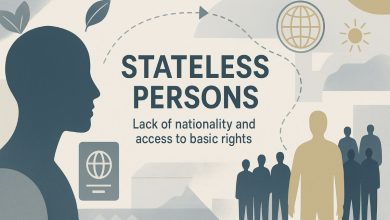
This structural absence of a state-centered guarantor of collective rights has important legal consequences. Statelessness in the Kurdish case is not a single phenomenon but a spectrum: from being a legally recognized national minority with limited civil rights, to being legally invisible or explicitly denationalized (for instance, through discriminatory registration practices), to becoming de jure stateless persons whose lack of nationality engenders practical exclusions (McDowall, 2004; McGee, 2023). The historical record underscores that statelessness among Kurds has both structural roots (border-making, state refusal to recognize group claims) and contingent triggers (population registration, wars, and administrative decrees).
Cultural suppression and language policies
State-led cultural assimilation has been a central instrument for marginalizing Kurdish identity. Across several states, policies have aimed at linguistic, cultural, and symbolic erasure—banning Kurdish-language education, restricting Kurdish media and place names, and criminalizing overt displays of Kurdish identity (McDowall, 2004). These measures are not simply symbolic; they are mechanisms that reshape status and belonging by subordinating non-dominant languages and historical narratives to the hegemonic national canon. The effect is to convert ethnolinguistic difference into evidence of political disloyalty, thereby reinforcing justification for both social exclusion and securitized responses.
Cultural suppression produces intergenerational consequences. When language transmission is interrupted, social and political capital associated with communal memory and collective mobilization is weakened, and formal rights—such as documentation, access to public services, and educational attainment—may be indirectly impaired. Moreover, the policing of cultural expression functions as an early warning signal for broader civic disenfranchisement: regimes that suppress language and culture often also limit associative freedoms, political representation, and access to justice. McDowall’s historical account illustrates how cultural restrictions have tracked phases of intense political competition and state consolidation, demonstrating the intimate link between cultural marginalization and the denial of political citizenship (McDowall, 2004).
Political struggles: armed, electoral, and civic forms of contestation
Kurdish political responses have been diverse: insurgency and armed resistance, negotiated autonomy arrangements, parliamentary politics, and nonviolent civil mobilization have all appeared in different times and places. The multiplicity of strategies reflects both heterogeneity within Kurdish society and the constraints imposed by differing state contexts (McDowall, 2004). In some cases, armed struggle emerged where political channels were closed or violently repressed; in others, negotiated autonomy (as in parts of Iraq after 1991 and post-2003 developments) provided limited institutional space for Kurdish self-rule. These different modalities demonstrate that Kurdish political action is not reducible to a single strategy but is conditioned by opportunity structures and by external actors (regional states, international patrons).
Contemporary political struggles also intersect with the problem of statelessness in concrete ways. McGee’s (2023) recent empirical study of stateless Kurds from Syria shows how individuals who lack or have lost nationality face acute difficulties in proving country of origin in asylum processes, are vulnerable to disbelief and procedural disadvantage, and may experience compounded exclusion when cultural markers deviate from state-centered notions of “national” identity (McGee, 2023). In short, statelessness is not merely a juridical status; it reshapes the political capacity of Kurds both within their home societies and in transnational displacement. The political implications are twofold: internally, statelessness weakens the ability of Kurdish individuals and communities to claim civic entitlements; externally, it complicates transnational advocacy and protection practices by producing ambiguous legal subjectivities that adjudicators and policymakers often mishandle.
International and regional responses: gaps and possibilities
International law and institutions provide partial instruments to address statelessness and minority rights, yet gaps in implementation and political will have constrained effective redress. Instruments concerning minority protections and statelessness exist, but as the empirical work shows, bureaucratic procedures (e.g., asylum credibility assessments and nationality determination) frequently lack the cultural and contextual sensitivity needed to adjudicate Kurdish claims fairly (McGee, 2023). Regional politics further complicate remedies: states that perceive Kurdish recognition as a threat to territorial integrity are reluctant to implement corrective measures, and international actors often prioritize stability over rights-based resolutions.
Nevertheless, there are openings for policy improvement. Two pragmatic avenues emerge from the evidence. First, embedding enhanced training and context-specific country-of-origin expertise into asylum and statelessness determination procedures would reduce the risk that stateless Kurds are disbelieved or misidentified (McGee, 2023). Second, supporting language rights and cultural restitution measures—through formal recognition of Kurdish education and media, and through legal protections for minority toponyms and cultural practices—could attenuate the structural drivers of marginalization identified in historical studies (McDowall, 2004). These reforms would not automatically resolve political claims to statehood, but they would materially improve civic inclusion and reduce the day-to-day vulnerabilities that follow from cultural suppression and legal invisibility.
Conclusion
The Kurdish experience illuminates how statelessness, cultural suppression, and political struggle are mutually reinforcing. Historical processes of boundary-making and nation-state consolidation produced a structural condition in which Kurdish collective claims could not be realized through conventional state institutions (McDowall, 2004). Contemporary statelessness—particularly visible among Syrian Kurds and those seeking protection in Europe—reveals procedural and substantive deficits in legal and humanitarian systems that compound cultural and political exclusion (McGee, 2023). Addressing these intertwined problems requires interventions at multiple levels: legal reforms and procedural training to protect stateless individuals; cultural and language policies to restore rights of expression and transmission; and political arrangements that permit meaningful participation without necessarily presupposing statehood. To move beyond cyclical marginalization, policymakers and scholars must center the lived legal realities of stateless Kurds and devise responses that are both rights-based and sensitive to the complex historical trajectories that produced their exclusion.
References
- McDowall, D. (2004). A Modern History of the Kurds (3rd ed.). I.B. Tauris.
- McGee, T. (2023). Challenges in Determining Country of Origin for Stateless Asylum Seekers: Kurds from Syria in the UK (Report). European Network on Statelessness.