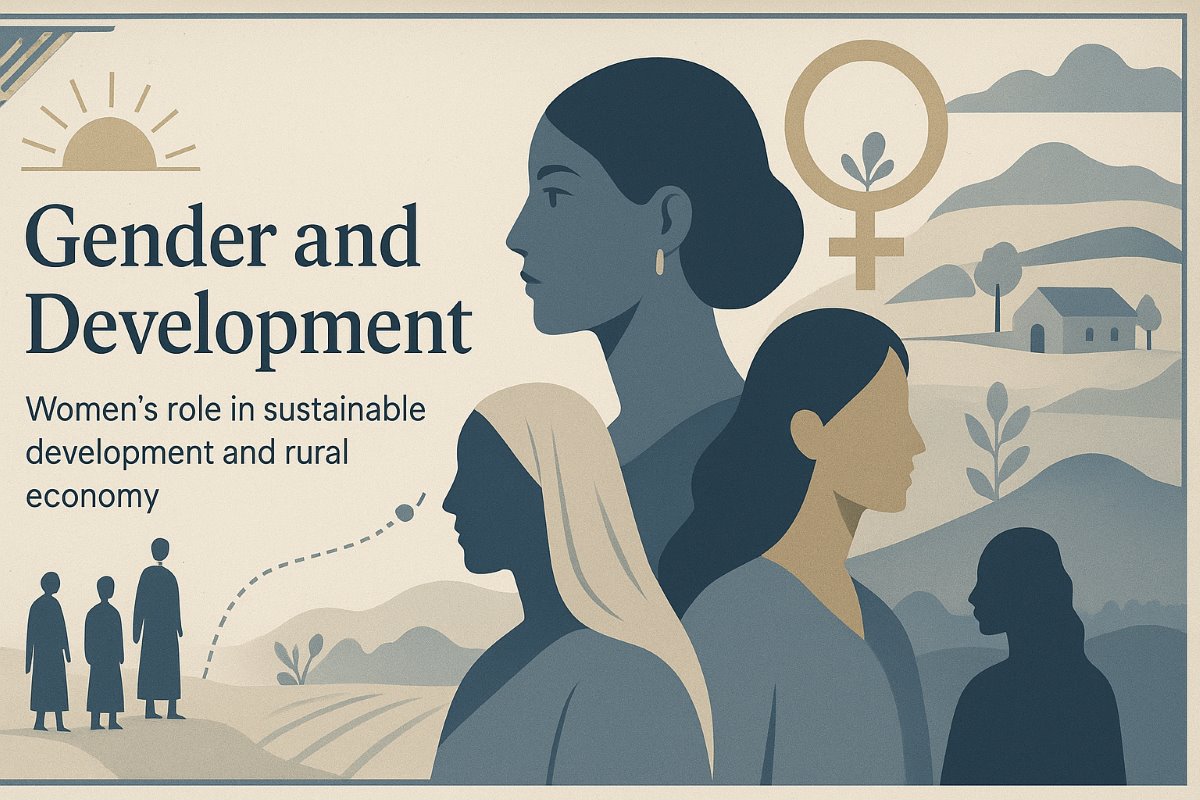
Gender and Development (GAD) scholarship argues that gender relations are not merely social differences but structures of power that shape access to resources, opportunities, and development outcomes. Unlike earlier Women in Development (WID) perspectives that emphasized integrating women into existing development agendas, the GAD approach examines how social relations—particularly gender norms—produce inequality (Boserup, 2007). In the context of sustainable development and rural economies, this perspective reveals that women are central economic actors, although their contributions frequently go unrecognized and undercompensated.
Women make up nearly half of the global agricultural labor force in many low-income countries (FAO & UN Women, 2023). Their labor sustains households, supports food systems, and contributes significantly to biodiversity conservation and climate resilience. Yet they face systematic constraints: unequal land tenure rights, limited access to credit, agricultural inputs, technology, and decision-making power (Doss et al., 2021). Addressing these barriers is essential not only for gender equality but also for achieving international development goals including the United Nations Sustainable Development Goals (SDGs), especially SDG 5 (Gender Equality) and SDG 2 (Zero Hunger).
This article examines women’s roles in sustainable development and rural economies through three interconnected lenses: economic contributions, structural barriers to empowerment, and the transformative potential of gender-responsive policy interventions. Drawing on both seminal and recent literature, it argues that sustainable development cannot be realized without the meaningful inclusion and empowerment of rural women.
Women’s Economic Contributions to Sustainable Development
Invisible yet essential labor
Women have long been central to rural economies. In her seminal work, Women’s Role in Economic Development, Ester Boserup (2007) demonstrated that women contribute substantially to agricultural production, household economies, and community wellbeing. She emphasized that traditional economic analysis systematically overlooks these contributions, writing that “women’s role in economic development has been consistently underestimated in economic analyses” (Boserup, 2007, p. 3). Her work shifted development thinking by revealing that women are not passive beneficiaries but active economic agents whose labor is essential to food production and rural survival.
In contemporary agricultural contexts, women engage in diverse activities—crop production, livestock management, household gardening, food processing, and local market trading. Yet their work is frequently categorized as “help” rather than formal employment. This invisibility distorts policy priorities and results in underinvestment in women’s productivity.
Women as drivers of sustainability
Recent global analyses confirm Boserup’s foundational conclusions. A comprehensive report by the Food and Agriculture Organization (FAO) and UN Women finds that reducing gender inequalities in agrifood systems has measurable macroeconomic benefits: “If women had the same access to resources as men, agrifood systems output could increase and the global economy could grow by US$1 trillion” (FAO & UN Women, 2023, p. xiii). Women tend to allocate a higher proportion of income to household nutrition, health, and education, producing intergenerational returns that align with the principles of sustainable development.
Women are often primary custodians of traditional ecological knowledge, particularly regarding seed selection, soil conservation, and water resource management. This knowledge contributes to biodiversity and strengthens climate adaptation strategies. Therefore, women’s participation in sustainable practices is not a matter of representation alone—it is a strategic imperative for ecological resilience.
Barriers to Equality in Rural Development
Unequal access to productive resources
Despite their contributions, rural women remain disadvantaged in access to land, finance, and agricultural inputs. Doss et al. (2021) argue that gender inequality in agricultural systems stems from structural constraints rather than individual limitations. They show that women’s productivity is reduced not because they are less competent farmers but because they have restricted access to productive resources such as quality seeds, fertilizers, and irrigation technologies.
Land tenure is the most pervasive constraint. In many regions, patriarchal inheritance systems prevent women from owning or controlling land. Without land titles, women struggle to access credit or participate in agricultural extension programs. These structural barriers reflect broader gender norms that define men as “farmers” and women as “helpers,” despite evidence of women’s substantial agricultural labor.
Time poverty and unpaid care work
Another barrier is time poverty caused by unpaid domestic and care labor. Rural women perform the majority of unpaid activities such as childcare, eldercare, cooking, and fuel and water collection. These tasks constrain their ability to pursue income-generating activities, attend training, or engage in local governance. According to Doss et al. (2021), interventions that overlook unpaid labor tend to reinforce existing inequalities rather than reduce them.
Limited participation in decision-making
Women remain underrepresented in farmer cooperatives, water management committees, and rural governance bodies. Decision-making inequality reduces the likelihood that women’s priority issues—such as access to clean water, local market infrastructure, or child nutrition—are reflected in policy agendas. Exclusion from leadership also perpetuates stereotypes that women lack technical knowledge or business skills.
Transformative Opportunities: Policy and Development Strategies
Gender-responsive policy and land reform
Evidence suggests that securing women’s land rights leads to multiple positive outcomes: increased agricultural productivity, improved household food security, and reduced gender-based violence. Land reform policies that issue joint land titles to spouses or prioritize women in land registration can transform gender relations. However, policy success requires implementation mechanisms that address resistance from local patriarchal institutions.
Investment in women’s agricultural productivity
Women farmers consistently achieve equal or higher yields than men when given equivalent access to inputs (FAO & UN Women, 2023). Investment should target:
-
Agricultural extension services tailored to women farmers
-
Access to climate-resilient seeds and technologies
-
Mobile banking and micro-credit programs
-
Digital tools for market information and price transparency
These interventions not only raise productivity but also increase women’s income and bargaining power within households.
Strengthening rural women’s cooperatives
Evidence shows that women’s cooperatives can overcome market exclusion by improving bargaining power and enabling collective saving, processing, and marketing. Cooperative models also provide social support networks that reduce vulnerability during crises. Empowering women to occupy leadership roles within these organizations helps transform gender norms and enhances community resilience.
Reducing unpaid care burden
Infrastructure development—such as clean water access, renewable household energy, and childcare facilities—reduces women’s time poverty. This is directly linked to increased participation in paid labor and entrepreneurship (Doss et al., 2021). Social protection systems (cash transfers, maternity benefits, caregiver allowances) further support women’s economic agency.
Conclusion
Women are indispensable to sustainable development and rural economic transformation. Their agricultural labor, ecological knowledge, and resource management practices form the foundation of food systems and environmental resilience. Yet, as Boserup (2007) revealed more than five decades ago, women’s economic contributions continue to be undervalued, obscured, and constrained by structural gender inequalities.
Current research and global data reinforce this conclusion. Closing gender gaps in agrifood systems would not only elevate rural women’s livelihoods and autonomy but also increase global economic productivity and contribute to sustainable development (FAO & UN Women, 2023). However, achieving these outcomes requires more than integrating women into existing development programs. It calls for transforming gender power relations through land rights reforms, equitable access to resources, investment in productivity-enhancing tools, and redistribution of unpaid care labor.
The Gender and Development approach thus remains essential: development is not gender-neutral, and sustainability cannot be realized without equity. Empowering rural women is not simply a policy choice—it is a development necessity.
References
Boserup, E. (2007). Women’s role in economic development. Earthscan. (Original work published 1970). ISBN 978-1-84964-239-2.
Doss, C., Meinzen-Dick, R., Quisumbing, A., & Theis, S. (2021). Women’s work, livelihoods, and agricultural productivity: Reframing the issues. Development Policy Review, 39(1), O1–O22. https://doi.org/10.1111/dpr.12527
Food and Agriculture Organization of the United Nations (FAO) & UN Women. (2023). The status of women in agrifood systems. Rome: FAO. ISBN 978-92-5-137610-5.