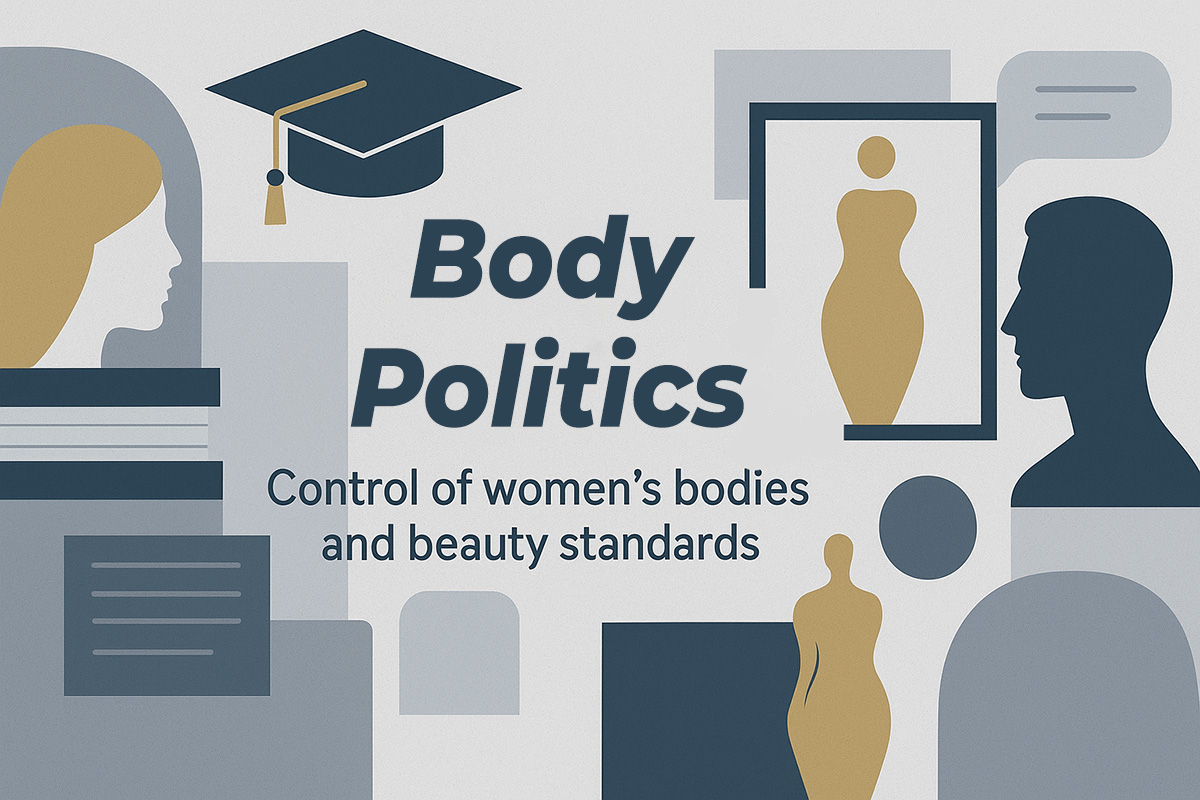
Body politics refers to the ways social institutions, cultural norms, and power structures regulate and control human bodies. While all bodies are subject to political and cultural rules, women’s bodies have historically been disproportionately regulated through legal, medical, religious, and cultural discourses. One prominent contemporary mechanism of control is the imposition of beauty standards, which function not merely as aesthetic ideals but as political instruments that discipline women’s behavior, consumption, and self-perception. Feminist theorists and sociologists have long argued that the regulation of women’s bodies is central to maintaining gender hierarchies (Bordo, 1993; Foucault, 1977). Recent research also shows that digital media, especially social media, amplifies these forms of regulation by making women feel continuously visible, evaluated, and compared (Rodgers et al., 2020).
The purpose of this article is to explore how body politics operates through beauty standards to control women’s bodies, drawing from feminist theory, social psychology, and cultural studies. The analysis highlights three major dimensions: (1) historical frameworks that conceptualize the body as an object of discipline, (2) cultural beauty norms and their consequences for women’s autonomy, and (3) the intensified surveillance and self-regulation brought on by digital media. Through a synthesis of seminal and recent scholarship, the article demonstrates that beauty standards serve as a subtle yet powerful system of control shaping women’s identities and possibilities for agency.
Theoretical Framework: Bodies as Sites of Power
Michel Foucault’s theory of disciplinary power is foundational for understanding body politics. In Discipline and Punish, Foucault (1977) argues that modern institutions regulate bodies through subtle mechanisms of surveillance, normalization, and self-monitoring. Although his work does not focus exclusively on gender, feminist theorists have applied his insights to explain how patriarchal social systems govern women’s bodies. Importantly, power operates not only through coercion but through internalization: individuals come to monitor and discipline themselves according to social norms (Foucault, 1977).
Susan Bordo (1993) expanded this analysis by examining how women internalize beauty standards, arguing that cultural pressures toward thinness, youthfulness, and sexual attractiveness function as forms of patriarchal control. She writes that the female body is often treated as “a medium of culture,” shaped by expectations of appearance and behavior (Bordo, 1993, p. 17). Women’s bodies become sites where broader cultural anxieties about sexuality, discipline, and femininity are enacted and controlled.
These frameworks suggest that beauty standards are not trivial or superficial; they are intrinsically political. By defining what counts as “attractive,” society also defines what counts as acceptable, respectable, and valuable in women’s lives. Thus, beauty norms act as disciplinary mechanisms that encourage women to invest time, money, and emotional labor into bodily management.
Beauty Standards as Social Regulations of Women’s Bodies
Beauty norms influence nearly every aspect of women’s lived experience—from daily routines to career opportunities. Historically, dominant standards in Western cultures have emphasized slimness, youth, and heterosexual feminine presentation. These norms shape women’s behaviors through cycles of dieting, cosmetic consumption, and cosmetic surgery. According to Bordo (1993), dieting functions as a modern form of discipline that teaches women to value self-control, obedience, and bodily restraint.
An important feature of this system is that women are encouraged to experience bodily dissatisfaction as an individual failing rather than as the effect of structural power. As Bordo (1993) notes, beauty culture is effective precisely because it shifts responsibility inward, making women believe they are voluntarily choosing to modify their bodies. Through this internalization, the system of control becomes largely invisible.
In Foucauldian terms, women become both the subjects and the instruments of discipline (Foucault, 1977). They monitor their own actions, critically evaluate their bodies, and adjust themselves to normative expectations without explicit coercion. This self-surveillance reinforces gender inequality because emotional energy directed toward bodily control could otherwise be directed toward political, intellectual, or personal pursuits.
The Economic Dimension of Beauty Norms
Beauty standards are also tied to economic structures. The global beauty and weight-loss industries profit from women’s dissatisfaction, promoting continual consumption of cosmetics, fashion products, and procedures. Bordo (1993) describes this as a cycle in which women are promised empowerment through self-transformation, yet the promise cannot be fulfilled because the standards are deliberately unattainable.
The commercialization of women’s insecurity produces significant profits. As women attempt to attain an idealized body, industries grow wealthier, and beauty norms deepen. Under capitalism, the body itself becomes a site of labor—something to be constantly improved, controlled, and streamlined.
Social Media and Intensified Self-Surveillance
While beauty standards long predate digital culture, the rise of social media has intensified scrutiny of the female body. Rodgers et al. (2020) conducted a systematic review and found that higher social media use is associated with increased body dissatisfaction and disordered eating outcomes among women and girls. Platforms such as Instagram expose users to carefully curated and filtered images, many of which conform to narrow beauty ideals. Rodgers et al. (2020) argue that constant exposure to idealized bodies encourages comparison, leading women to believe that they must reshape their bodies to achieve social acceptance.
The digital environment enhances what Foucault (1977) describes as the metaphorical “panopticon.” Women exist under permanent visibility; any image they post becomes subject to evaluation through likes, comments, and metrics of popularity. This produces an environment where women are encouraged to perform femininity for an audience, reinforcing the idea that bodily appearance determines social worth.
Although social media is sometimes framed as empowering—allowing self-expression and visibility—the pressure to curate a flawless image often leads to increased anxiety. The logic of digital beauty culture transforms the body into a public project requiring continuous optimization. As Rodgers et al. (2020) show, this pressure is especially harmful for adolescents, who are still forming their identities.
Consequences for Autonomy, Identity, and Social Participation
The control of women’s bodies through beauty norms has far-reaching consequences. At the psychological level, internalizing unattainable expectations can lead to chronic dissatisfaction. Women may restrict food intake, pursue costly cosmetic procedures, or avoid public spaces when they feel their bodies are not “acceptable.” At the social level, body regulation reinforces gender inequality by directing women’s time, money, and energy into appearance rather than into education, careers, or political engagement.
These dynamics also shape identity formation. If a woman learns early that her value lies in her appearance, she becomes more likely to define herself through external validation. This dynamic reinforces gender stereotypes, sustaining the belief that women exist primarily to be looked at. Feminist theorists argue that reclaiming bodily autonomy requires challenging beauty norms at a cultural level, rather than pressuring individual women to resist them alone (Bordo, 1993).
Conclusion
Body politics reveals that control over women’s bodies is not merely a matter of personal preference or aesthetics; it is a form of social power. Beauty standards serve as subtle mechanisms of discipline that encourage women to monitor, evaluate, and modify their bodies to conform to cultural expectations. Drawing from the theoretical frameworks of Foucault and Bordo, we see that these standards create systems of power in which women internalize norms and self-regulate, believing they are acting freely. Contemporary digital culture further intensifies this control by subjecting women’s bodies to constant visibility and comparison (Rodgers et al., 2020).
Ultimately, challenging beauty standards is not simply about promoting body positivity—it is about resisting a system of governance that restricts women’s autonomy, identity, and social participation. Feminist scholarship demonstrates that bodily control is political, and pushing for broader definitions of beauty—or dismantling beauty hierarchies altogether—is a critical pathway toward gender equality.
References
Bordo, S. (1993). Unbearable weight: Feminism, Western culture, and the body (10th ed.). University of California Press. ISBN 9780521462843.
Foucault, M. (1977). Discipline and punish: The birth of the prison (A. Sheridan, Trans.). Vintage Books. ISBN 9780679752554.
Rodgers, R. F., Slater, A., Gordon, C. S., McLean, S. A., Jarman, H. K., & Paxton, S. J. (2020). A systematic review of the impact of social media usage on body image and disordered eating outcomes. Body Image, 33, 251–264. DOI: 10.1016/j.bodyim.2020.02.006.